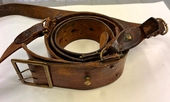
Russian Empire. The lanyard infantry to cold weapon of officers and military officials.
1. The small - eur. (sold)
2. The big - sold
3. From sable - 590 eur.
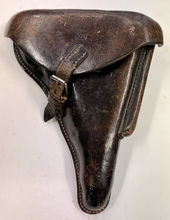
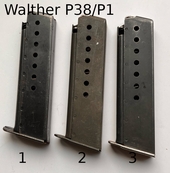
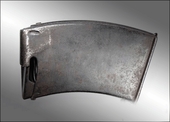
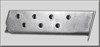
Germany. Magazine for the Walther pistol of various modifications and release periods.
All stores on WW2 are stamped with the military acceptance stamp of the 3rd Reich (WaA) and the manufacturer's code. 9mm parabellum
1.Walther P38 WWII with waffenamt (WaA) - 170 euros. 2.Walther P38 of the post-war period - 70 euros. 3.Walther P1 produced by GDR - 50 euros.
Walther PP 7,65mm
1.Walther PP WWII - 120 euros sold 2.Walther PP WWII - 120 euros sold 3.Walther PP WWII - 120 euros sold 4.Walther P 04 - 50 euros 5.Walther PP post-war - 70 (temporarily not) 6.Walther PP post-war with extension cord - 70 (temporarily not available)
7. Walther PP with extension cord - 130 eur. sold
Walther PPK 7,65 mm
1.Walther PPK WWII - 120 euros. 2.Walther PPK post-war issue - 70 euros. 3.Walther PPK post-war with extension cord - 90 euros (sold )
4. Walther PPK Manurhin (post- war issue) - 60 euro.
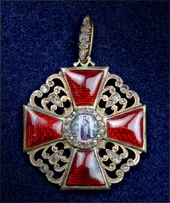
The Russian Empire. The insignia of the Order of St. Anne for foreigners. (sample from 1829-1911). The oficial sample. About 2,800 people were awarded the badge of this type.
This badge of distinction was awarded to foreigners who did not have a noble title and, by their position, were not eligible to receive the Russian order. This category mainly consisted of foreign nationals who accompanied foreign dignitaries during trips or visits to Russia.
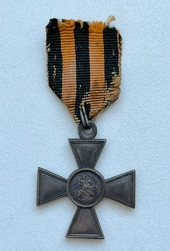
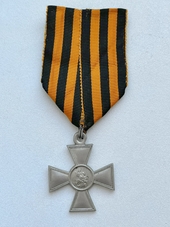
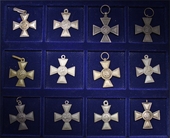
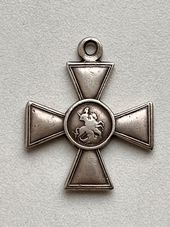
The Russian Empire. A set of awards and documents addressed to private Yakov Martynovich Strumer of the 45th Infantry Azov Regiment, who was awarded the Insignia of the Military Order (St.George order) of the 4th class, number 84021, awarded to him on November 7, 1877 for his distinction in dealing with the Turks on the 7th of the same month and year in the village of Pyrgos ? (not legible).
EXTRA RARE !!!
Russian Empire. Bebut is a dagger of a soldier's curve of 1907. Manufactured by an arms factory in Zlatoust in 1911.
The blade is steel, slightly curved, with two narrow lobes on each side. The handle is figured, narrow in the middle part. Installation of the cover handle: wooden cheeks, painted black, riveted with two brass rivets. RARE EARLY VARIANT WITHOUT brass shackle bushing (appears since 1912). Wooden sheath, covered with leather, with a metal device. The device consists of a mouth, a bracket with a cord ring, on which the dagger is suspended to the waist belt and a tip (toe) ending with a ball.
There are Latin letters on the cheeks of the handle and the sheath clip - the code of the Finnish unit (JPI - Jona sapper battalion ???)
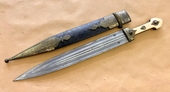
Russian Empire. An army dagger (Kinzal) of the Caucasian type, made at the Zlatoust arms factory in 1905 by order of the GAU (ГАУ). At the mouth there is a military stamp "2 B. 24 M.A.D.2" - 2 battery, 24 Mortar Artillery Division, weapons number according to the list of 50. Blade of diamond-shaped section with three lobes. On the obverse of the blade is the ZOF stamp and the year of release, on the reverse are the receiving stamps of the Main Artillery Directorate the capital letter "A" with the crown and simply "A." The handle of the traditional type for daggers, wooden, painted black, is attached with three "cloves." The scabbard is wooden, covered with black leather. The device is made of light bronze with gilding. A very rare and extremely interesting item for a true collector.
USSR. 1934-39 The badge "Voroshilovsky Red Army rifleman of the II stage" for the NKVD troops. On the reverse are the letters "NKVD".
The badge was introduced into the Red Army and the Red Navy by order of the USSR Strategic Missile Forces No. 92 dated June 8, 1934, to reward Soviet citizens who mastered small arms and successfully passed the relevant standards, including shooting with small arms. The Voroshilovsky Shooter badge was issued for passing the standards using the TOZ8 small-caliber sports rifle since 1933 and the TOZ9 with an open or diopter sight. In addition, the applicant was required to have good general physical training and active participation in the affairs of the defense organization.
A magnificent, beautiful sign, a chic grill under vitreous enamel. Very rare.
The Russian Empire. The badge of the Order of St. Annas of the 2nd class with swords. The years 1908-1915. The badge was made by the jewelry company "Eduard". On the reverse of the upper beam is the stamp of the workshop "VD". On the lower "Edward". On the ear is the assay stamp of the St. Petersburg tent after 1908 - "56", a woman's head in a cocoanut.On the hilt of the swords and the earring of the pendant is a badge of satisfaction (a woman's head in a cocoanut).
A magnificent example of a late capitular sign. Perfect preservation.
The Republic of Estonia. Star of the Order of the Eagle Cross for Civil Merit. The First Republic of 1928-40.
An eight-pointed silver diamond-cut star, on top of which is fixed the badge of the Order of the Eagle of the first degree. It was worn on the left side of the chest.
The Order of the Eagle with a star was mainly awarded to ambassadors and high-ranking guests (presidents, famous political figures who visited the Republic of Estonia).
Rare!
The Russian Empire. Badge of the Order of St. Vladimir, 4th degree with swords and a bow. The production period was after 1908. On the reverse of the eyelet is the stamp of the St. Petersburg assay chamber "56" with a female head in a cocoanut and the stamp of the manufacturer "A.R." (presumably Alexander Romanov). There are also control stamps "a woman's head in a cocoanut" on the hilt of the swords. The size of the sign has been increased.
A magnificent rare specimen.
The last photo was taken to compare the size with the capital sample.
Russian Empire. Order of the Holy Equal-to-the-Apostles Prince Vladimir 4th degree with swords and bow, for military merits. It was made in the Eduard workshop - the expanded name of the workshop on the reverse of the lower beam, the stamp on the upper beam of the VD reverse (Vera Dietwald)., a sign of adoption on the handles of swords (a woman's head in a kokoshnik) and 56 gold samples on the ear.
Russian Empire. Orden of the St. Vladimir of the 4th degree. St.-Petersburg, 1873-1882. Keybel. Brands on about. Art. of the badge of an award: on an ear — test of 56 metal with a city brand of St.-Petersburg; on the ends of a cross under enamel, above — the State Emblem, below — a personalized brand of "IK" - Yiogan Keybel.
Russian Empire. Medal "In memory of the reign of Emperor Nicholas I" 1825-1855.
It was established on April 30, 1896, in memory of the 100th anniversary of the birth of Emperor Nicholas I. The bronze medal was awarded to all lower ranks who were in active service during the reign of Emperor Nicholas I.
More than 220,000 bronze medals were minted at the St. Petersburg Mint.
Russian Empire. Picture of officers and lower ranks of the 5th Company of the 1st Infantry Regiment, Finland. Photo "Renessans" SPB. On the reverse the inscription
The Russian Empire. Epaulettes of the lieutenant colonel of the Guards regiments of the Russian Imperial Army, or the General Staff.
An extremely rare set in excellent preservation. Museum value. It's unique.
The Russian Empire. The Order of St. Stanislava of the 3rd degree with swords. On the reverse of the lower beam is the brand of the workshop "DO" - Dmitry Osipov. At the ends of the swords, a woman's head is a sign of satisfaction. On the ear is an assay stamp of the early 20th century - "56", a female head in a cocoanut, the initials of the assay master "ЯЛ".
A very beautiful grill is distinguished by all the badges of the orders made in Dmitry Osipov's jewelry workshop. Excellent condition.
The Russian Empire. Badges of the Order of St. Anna of the 2nd degree "AK" in a case.
The brand of the AK workshop is Albert Keibel on the lower beam curtain. On the reverse of the upper beam, the state coat of arms is an eagle, a sign of the issuance of orders from the chapter house. On the "ear" is an assay stamp of the early 20th century "56", a female head, the initials of the assay master "YAL". The case is covered with red calico with an inscription, in three lines, on the lid in gold paint (Badges of the Order of St. Peter the Great).Anna of the 2nd degree).
The Russian Empire. The badge of the Order of St. Anna of the 2nd degree with swords in a case. On the curtain of the lower beam is the brand of the workshop "IK" - Johann Keibel. On the reverse of the upper beam, the state coat of arms is an eagle, a sign of the issuance of orders from the chapter house. On the "ear" is an assay stamp of the last quarter of the 19th century "56" and the coat of arms of St. Petersburg. The case is covered with red calico with the inscription, in two rows, on the lid in gold paint (St.Anna 2 art. with swords) and the state emblem - the eagle.
An extremely rare collector's item. In perfect condition.
The Russian Empire - Romania. A cross for crossing the Danube. During the Russian-Turkish War of 1877-78. The Romanian Cross was awarded to Russian servicemen, among others.
The Russian Empire. Emigration. The Order of St. George, 4th degree, made in exile (presumably in the Czech Republic) from two halves of the German Order of the Red Eagle.